
2026 Analytics & AI Predictions for Data-Forward SMBs
 Allan WillePublished 2025-12-19
Summary: In 2026, SMB success with AI will hinge on meaning, not more tools. Expect the metric layer to become standard, dashboards to be insightful, hybrid data access to win, and explainability to be non-negotiable. Here is what business leaders should expect—and prepare for.
The metric layer becomes table stakes
By 2026, the debate over whether you need a metric layer will be over. Instead, leaders will be auditing their "Metric Debt"—the cost of inconsistent definitions that lead to wasted meetings and boardroom arguments over whose version of "Gross Margin" is correct. As self-serve data access becomes the norm, inconsistent logic becomes a liability that erodes trust.
A strong metric layer provides a single, governed definition for core KPIs like revenue, churn, and pipeline. PowerMetrics helps you pay down metric debt by creating a centralized, business-language catalog. By certifying what matters and providing clear lineage, you ensure that growth compounds clarity rather than multiplying confusion.
AI stays assistive and the rise of metadata
In 2026, the bottleneck for AI in the enterprise won't be model horsepower; it will be a lack of context. Blind trust in automated decisions remains low because LLMs are prone to "hallucinating" logic when data is messy. The real winners will use AI not as a black box, but as a guided assistant.
PowerMetrics provides the guardrails that keep AI honest. By anchoring natural language queries to defined metrics rather than raw, ad-hoc fields, you ensure the AI "knows" the business logic before it speaks. When the meaning is governed, AI becomes a reliable partner that points back to source truths, rather than a risky shortcut.
Dashboards evolve into insight interfaces
The "static chart" is a relic of the past. In 2026, leadership needs more than visual alignment; they need diagnostic power. Dashboards are shifting from passive displays to live interfaces where the "what" and the "why" live side-by-side.
The value is no longer the chart itself, but the ability to perform diagnostic analytics without a data science degree. PowerMetrics makes this shift practical. Users can jump from a performance spike to the underlying definition and source data without losing the thread. Your dashboard stops being the end of the journey and starts being the gateway to deeper, actionable understanding.
Warehouses grow while hybrid access stays critical
As SMBs scale, the data warehouse becomes the "Library"—the place for durable, modelled, and highly organized core metrics. But business moves faster than a warehouse pipeline. Reality stays messy, requiring a "Newsroom" approach for experimentation—direct connections to apps, spreadsheets, and other data feeds.
PowerMetrics supports both scenarios. You can connect to your warehouse for long-term governance while maintaining flexible, direct paths to services for immediate agility. This hybrid design allows you to promote "Newsroom" insights into the "Library" once they’ve proven their value, ensuring speed never comes at the expense of rigor.
Data pros shift focus from pipelines to business logic
In 2026, the mechanical work of moving data is largely commoditized by AI and automated tooling. This frees your data team from being "data janitors" to becoming "meaning architects." Their value no longer lies in maintaining the plumbing, but in ensuring the integrity of the logic. Their focus shifts to quality assurance, semantic documentation, and the governance that makes data safe for the rest of the company.
PowerMetrics enables this high-value shift. Instead of building bespoke reports for every request, data pros define a metric once and distribute it everywhere. By building the guardrails, they empower business users to self-serve safely, turning the data team from a bottleneck into an engine of scale.
Alignment is the new velocity
The companies that move the fastest won't be those with the most data, but those with the most alignment. The biggest friction point in an SMB is "metric fragmentation"—where Marketing, Sales, and Finance spend half their meeting debating which revenue number is correct.
PowerMetrics turns alignment into a daily practice. By hosting a single, centralized metric catalog, you provide a shared language for the entire organization. When everyone uses the same definitions, the conversation shifts instantly from "is this number right?" to "what is the data telling us to do?"
Reasoning and explainability
As AI becomes embedded in analytics, "Trust but Verify" becomes the mantra of the owner-led business. If a system flags a trend or suggests a pivot but cannot explain its reasoning, it will be ignored. In 2026, transparency is the prerequisite for adoption.
PowerMetrics is built for this "glass-box" era. Every insight carries its own "passport"—definitions, ownership, logic, and links back to the source. When an AI summary highlights a pattern, users can peel back the layers to see exactly how that conclusion was reached. Confidence grows because the logic is visible, not hidden.
The new SMB data stack: clear and modular
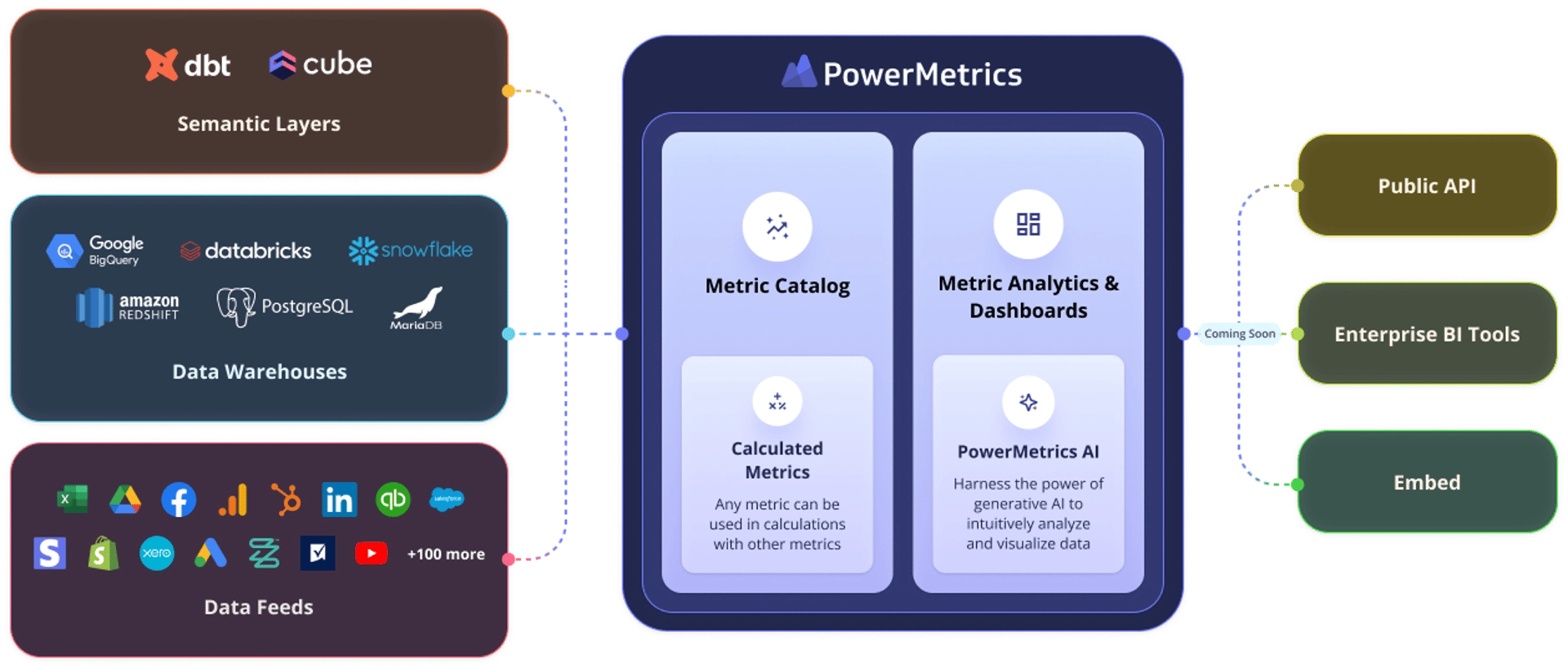
Traditional analytics is giving way to a modular, best-of-breed stack where roles are clearly defined.
- Source Systems: Record the transactions.
- Warehousing: Stores and models the history.
- The Metric Layer (PowerMetrics): Acts as the Control Plane, standardizing meaning and governing the logic.
- The AI Layer: Acts as the interface, summarizing and assisting based on that logic.
This modularity ends the false choice between AI and human oversight. AI doesn’t replace the semantic layer; it requires it. The better your metric definitions, the more powerful your AI outputs become.


What to prioritize now
Success in 2026 requires a shift in mindset today. Don't focus on more dashboards; focus on more trusted dashboards.
- Build your "Source of Truth": Start with a small set of certified metrics in a shared catalog.
- Favour Interactive Insight over Static Reporting: Choose tools that allow users to filter, segment, and ask "why."
- Audit for Explainability: If your team can’t explain where a number comes from in 30 seconds, your system is failing.
PowerMetrics is the foundation for this agenda. Start by certifying your core metrics, bring them into interactive dashboards, and give your team the confidence to self-serve. Use MetricHQ to benchmark your definitions against industry standards and expand your catalog as your culture of trust takes hold.